
Ride-On Cars With Bluetooth Music: A Parent's Guide
Table of Contents
- What Makes Ride-On Cars With Bluetooth Music Special
- Two-Seater Ride-On Cars: Sharing the Adventure
- Understanding 24V Ride-On Cars for Kids
- Ride-On Cars With Parental Remote Control: Peace of Mind
- Battery Life for Kids' Ride-On Cars: What to Expect
- Key Safety Features and Age Suitability
- Choosing the Right Vehicle Type for Your Child
- Frequently Asked Questions
Last Updated: October 14, 2026
What Makes Ride-On Cars With Bluetooth Music Special
Ride on cars with bluetooth music combine independent driving with entertainment that keeps kids engaged for hours. At VroomVroomToy, we've designed our ride-on cars with Bluetooth music to deliver both fun and safety, giving parents peace of mind while their children explore their own driving adventures.
Beyond novelty, children get realistic vehicle operation with working lights, authentic engine sounds, and music streaming through built-in speakers.
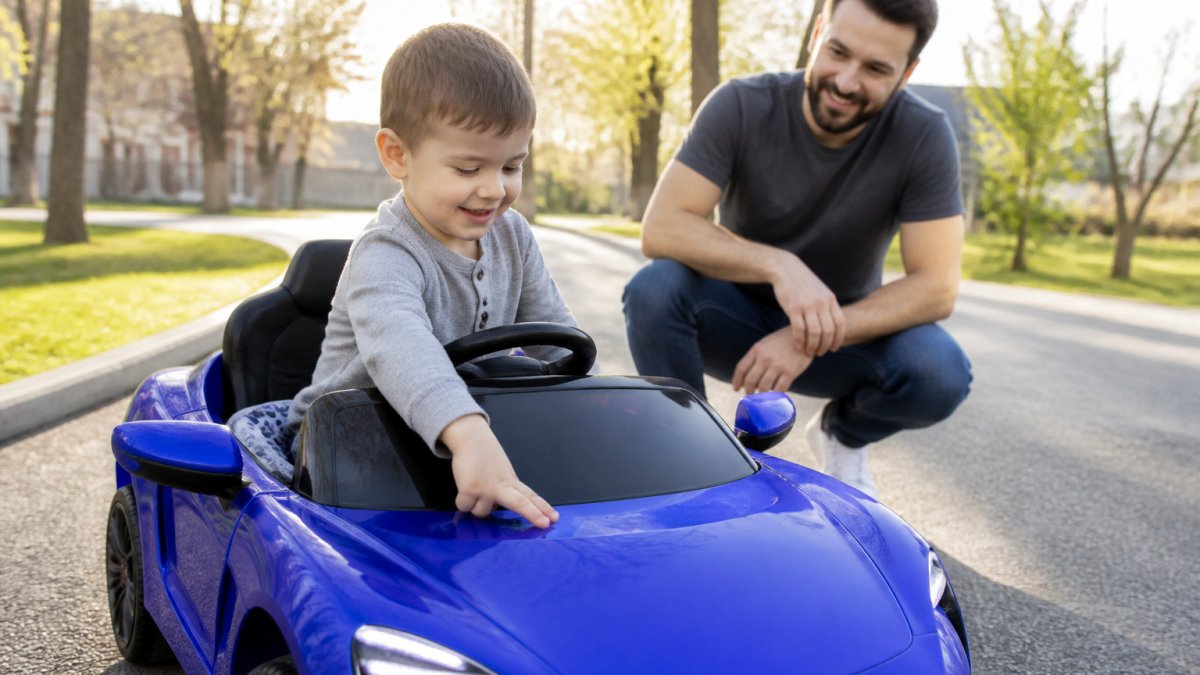
How the Bluetooth Audio Actually Works
Practical notes most listings skip:
- Pair one device at a time. If a parent's phone is still paired from the last session, a child's tablet may not connect until you disconnect the first device.
- Keep the phone within about 30 feet. Bluetooth range shrinks when the phone is in a pocket behind a metal garage door or inside a house.
- Charge the vehicle before pairing. Some audio boards won't power on if the main battery is below a certain threshold.
- If pairing fails, power-cycle both devices. Turn the vehicle off, turn the phone's Bluetooth off and back on, then retry. This resolves the majority of connection issues.
Bluetooth vs. USB, AUX, and Built-In Music
Not every ride-on car with "music" supports phone streaming. Before buying, confirm which audio sources the model actually offers:
| Audio Source | What It Does | Trade-Off |
|---|---|---|
| Bluetooth | Streams from a paired phone or tablet | Requires a charged device and pairing each session |
| USB port | Plays MP3 files from a flash drive | You must load songs ahead of time; no streaming |
| AUX / 3.5mm jack | Plays from any device with a headphone jack | Cable can snag; many newer phones lack the port |
| Built-in tracks | Preloaded songs and engine sounds | No customization; often a short, repeating loop |
Many vehicles combine two or three of these; Bluetooth plus USB gives you a fallback when a phone dies mid-play.
Audio Safety for Young Ears
Speakers sit close to a child's head, so volume discipline matters more than with a living-room speaker. Guidelines most pediatric audiology sources echo:
- Cap volume at roughly half. Start low and only raise it enough to be heard over the motor.
- Keep sessions short. Long, loud listening is the bigger risk, not a single song.
- Preserve ambient sound. Your child should still hear you, traffic, and other kids. If you have to shout to be heard, the music is too loud.
- Skip headphones. Earbuds and over-ear headphones block the warnings a child needs while operating a moving vehicle.
Treat the audio system as a feature you verify, not one you assume. Check the spec sheet for "Bluetooth," "USB," or "AUX", the word "music" alone doesn't guarantee phone streaming.
Two-Seater Ride-On Cars: Sharing the Adventure
Two-seater ride-on cars let siblings or friends share the driving experience, with a driver's seat with controls and a passenger seat, eliminating the need to buy separate vehicles.
The shared experience teaches cooperation: one child drives while the other rides, then they switch roles. This works especially well for children aged 4-8, whose age gap often falls within the safe operating range for the same vehicle.
Verify your children's combined weight stays within the manufacturer's limits; over capacity drains the battery faster and strains the motor.
Two-seaters take up roughly 40% more yard space than single-seaters, so measure before committing if your play area is limited. VroomVroomToy's two-seater ride-on cars with Bluetooth music use compact designs that still deliver the full feature set, music, lights, and parental controls, without dominating your yard.
Understanding 24V Ride-On Cars for Kids
24V ride-on cars for kids deliver significantly more power than their 6V and 12V counterparts. Voltage directly affects performance: speed, hill-climbing ability, and battery runtime.
Here's how the voltage spectrum breaks down:
- 6V models: Best for toddlers aged 2-4, maximum speed 2-3 MPH, ideal for flat terrain
- 12V models: Suited for children 3-6, speeds up to 5 MPH, handles slight inclines
- 24V models: Designed for ages 5-8, speeds reaching 7-10 MPH, tackles steeper hills and rougher terrain
Always use the charger provided by the manufacturer.
Ride-On Cars With Parental Remote Control: Peace of Mind
Ride-on cars with parental remote control let you steer, accelerate, and brake from up to 100 feet away, addressing parents' primary concern: whether their child can handle a moving vehicle safely.
The 2.4GHz frequency used in quality ride-on cars with parental remote control operates on a secure, interference-free channel.
Your child operates the vehicle independently using foot pedals and a steering wheel. If they head toward danger, a driveway edge, a pet, a sibling, you take control instantly, since the remote overrides the child's input. This graduated approach builds driving confidence while maintaining safety.
Most parents need the remote most during the first few sessions; by week two or three, many rarely touch it except for emergencies.
VroomVroomToy's ride-on cars with parental remote control maintain reliable signal across typical home environments.
Battery Life for Kids' Ride-On Cars: What to Expect
Battery life for kids' ride-on cars depends on voltage, terrain, driving style, and battery condition.
What Actually Drains the Battery
Real-world factors reduce these estimates:
- Constant acceleration and braking cuts runtime by 20-30%
- Hilly terrain drains batteries 25-40% faster
- Cold weather reduces battery efficiency by 10-15%
- An older or partially charged battery delivers less runtime than a fresh one
- Bluetooth audio use adds a small but real draw, typically 5-15 minutes off a full session, more if the volume is high
- Heavier riders draw more current on every start; a vehicle rated for 66 pounds will run longer with a 40-pound child than a 60-pound one
- Tire type matters. Hard plastic wheels roll freely on pavement but drag on grass; rubber or EVA foam tires grip better off-road but cost a little range
Charging: Times, Habits, and Costs
Charging takes 8-12 hours for a full charge on most models, so plan overnight charging. Partial charges work fine for short sessions.
A few charging habits that extend battery life:
- Don't leave the battery fully discharged for weeks. Recharge to roughly half before storing.
- Use only the charger that came with the vehicle. Voltage and amperage must match the battery.
- Charge in a dry, room-temperature spot. Extreme heat or cold shortens battery lifespan.
- Unplug once the indicator shows full. Overcharging is a common cause of early battery failure.
Replacement batteries are a real ownership cost.
Runtime by Voltage at a Glance
| Voltage | Typical Runtime | Typical Charge Time | Best For |
|---|---|---|---|
| 6V | 45-90 min | 8-10 hrs | Toddlers, flat pavement |
| 12V | 60-90 min | 8-12 hrs | Most families, mixed terrain |
| 24V | 45-90 min | 10-12 hrs | Older kids, hills, off-road |
Plan play sessions accordingly, or purchase a second battery if your child wants extended driving time without waiting for a recharge.
Key Safety Features and Age Suitability
Safety features separate quality ride-on cars from budget alternatives.
Seat belts: A proper seat belt keeps your child secure during turns and stops. Look for three-point harnesses rather than lap belts alone. VroomVroomToy's ride-on cars include secure seat belt systems designed for children's proportions.
Suspension: A four-wheel suspension absorbs bumps and rough ground, reducing jolting and improving stability, especially on uneven terrain.
Speed governors: These limit maximum speed to safe levels based on age. A ride-on car set to 3 MPH for a 4-year-old and 7 MPH for an 8-year-old prevents dangerous speed situations.
Automatic braking: Quality ride-on cars stop automatically if the driver releases the pedal. This prevents rollaway and gives you an extra safety layer.
Maturity matters as much as age: a cautious 5-year-old might handle a 12V vehicle safely, while an impulsive 7-year-old might need a lower-voltage model with speed restrictions. Observe your child during the first few sessions to confirm they're ready.
Choosing the Right Vehicle Type for Your Child
Vehicle type shapes the entire experience. The right choice matches your child's interests and your environment.
Sports cars and supercars: Realistic designs with working doors, detailed interiors, and authentic styling appeal to children who love speed. These typically come in 12V and 24V versions with Bluetooth music built in, best for ages 5-8 who want an immersive driving fantasy.
Trucks and SUVs: Larger vehicles with higher ground clearance handle rougher terrain better and appeal to children interested in adventure. Trucks often include cargo beds or storage compartments, adding practical play elements.
ATVs and utility vehicles: Designed for off-road capability, these models feature aggressive tread tires and rugged suspensions. They work well for yards with grass, gravel, or slight slopes. Best for children 6-8 who prefer exploring over high-speed driving.
Bumper cars: Designed for multi-child interaction, bumper cars let kids drive and gently bump each other in controlled environments. These work best for supervised group play and teach spatial awareness.
Consider your yard's terrain. A flat driveway suits any vehicle type. Grass and slopes favor trucks, SUVs, and ATVs with better ground clearance and traction. Limited space favors compact sports cars.
Consider your child's interests too: a child obsessed with police vehicles will engage more with a police car design, and this emotional connection drives playtime frequency and satisfaction.
| Vehicle Type | Best Age Range | Terrain Suitability | Speed Range | Top Feature |
|---|---|---|---|---|
| Sports Car | 5-8 | Flat, smooth | 5-10 MPH | Realistic design, speed |
| Truck/SUV | 4-8 | Mixed, with slopes | 4-8 MPH | Ground clearance, cargo |
| ATV | 6-8 | Off-road, rough | 5-9 MPH | Traction, suspension |
| Bumper Car | 4-7 | Flat, open | 3-5 MPH | Multi-child play |
Ride-on cars with Bluetooth music are a significant investment in your child's outdoor play and development. Choosing a model with parental remote control and quality Bluetooth audio prioritizes safety and longevity alongside fun.
At VroomVroomToy, we build ride-on cars with Bluetooth music that balance these priorities. Our vehicles feature 2.4GHz parental remote control, four-wheel suspension, and built-in music systems. We back every purchase with USA-based customer support and a 30-day return policy, so you can feel confident in your choice. With free shipping on every order, getting your child into their dream ride-on car is easier than ever.
Frequently Asked Questions
What age is appropriate for a ride-on car with Bluetooth music?
Most ride-on cars with Bluetooth music are designed for children ages 3 to 8, though some models accommodate up to age 12 depending on weight capacity and vehicle size. Younger children (3-5) benefit from parental remote control features, while older kids can operate independently with adult supervision. Always check the manufacturer's weight and age recommendations before purchase.
How long does the battery last in a 24V ride-on car?
Battery runtime depends on terrain, speed settings, and weight. Flat surfaces and lower speed modes extend battery life. Regular charging after each use and proper storage during off-season helps maintain battery health and longevity.
Can parents control a ride-on car with a remote?
Yes, most modern ride-on cars include a 2.4GHz parental remote control that allows adults to steer, accelerate, and brake independently. This feature is especially valuable for younger drivers or beginners, letting you take control if needed while your child learns.
Do ride-on cars with Bluetooth music also have USB or AUX input?
Many ride-on cars with Bluetooth connectivity also include USB and AUX ports for flexibility. This allows you to stream music via Bluetooth from a smartphone, play MP3 files from a USB drive, or connect via a standard 3.5mm AUX cable. Check individual model specs, as audio input options vary, some offer all three, while others focus primarily on Bluetooth.


