
Are Expensive Ride-On Cars Worth It? A Parent's Guide
Last Updated: October 23, 2026
Quick Summary
Yes, expensive ride-on cars are worth it when you pay for safety, durability, and multi-year use rather than size alone, since price and quality do not move in lockstep. A $559 ride-on used for four years costs about $140 per year, less than a $200 one that dies in two seasons.
- Dual motors and four-wheel suspension are the upgrades that earn their price; licensed styling and LED lights are mostly cosmetic.
- A 2.4GHz remote with emergency stop is the single biggest safety upgrade in the category.
- Most ride-on cars last three to five years, but age-out usually ends their run before breakdown.
- The purchase price is roughly 70% of what a premium ride-on actually costs over four years.
- Skip premium if your child is already 9 or 10 and near the weight limit, or the car will be used a handful of times a year.
Table of Contents
- Are Expensive Ride-On Cars Worth It? The Honest Answer
- Budget vs. Premium Ride-On Cars: What Your Money Actually Buys
- The Best Electric Ride-On Cars for Kids: What Separates the Top Tier
- Kids' Electric Car Safety Features That Justify the Price
- How Long Do Ride-On Cars Last? Durability and Age-Out Risk
- Total Cost of Ownership: The Math Behind a $559 Purchase
- Battery Life, Motor Power, and Real-World Performance
- Who Should Buy Premium (and Who Shouldn't)
- Frequently Asked Questions
Are Expensive Ride-On Cars Worth It? The Honest Answer
Yes, expensive ride-on cars are worth it when you buy for safety, durability, and multi-year use rather than size alone. A higher price may reflect a stronger power system, two seats, or styling, not a better vehicle for your child, according to LA Toyz's premium ride-on buyer's guide.
Here is the part most guides skip: a $559 ride-on that lasts four years costs less per year than a $200 one that dies in two seasons. Below, we break down what separates budget from premium, the safety features that justify the spend, and who should skip the upgrade entirely.
Ride-on cars are battery-powered child vehicles with a seat, steering, pedals, and often a parental remote. The premium tier adds real suspension, dual motors, and supervised control.
Budget vs. Premium Ride-On Cars: What Your Money Actually Buys
The gap between a $200 ride-on and a $559 one shows up in four places: suspension, motor count, control electronics, and build material. But the honest question is not what the extra money buys, it is which of those upgrades you will actually feel, and which are mostly cosmetic. Here is a feature-by-feature value test you can run before checkout.
The upgrades that earn their price
Dual motors. A single-motor car handles flat pavement and nothing else. Dual 25W motors pull a rider up a slight incline and through short grass without stalling.
Four-wheel suspension. Suspension is a comfort feature with a safety payoff.
A 2.4GHz remote with emergency stop. This is the single biggest safety upgrade in the category. A basic remote offers one speed and a forward/reverse switch.
Soft start. Premium electronics ramp acceleration gradually instead of jolting forward.
The upgrades that are mostly cosmetic
Licensed styling and badging. A branded body sells the first ride, not the hundredth. It adds cost without adding capability.
Hydraulic or butterfly doors, sirens, and megaphones. These are fun and they impress a child, but they do nothing for safety, durability, or runtime.
LED light packages and sound systems. Nice on a driveway at dusk; irrelevant to how the car performs or how long it lasts.
How to read the price tiers
| Tier | Typical Price | What You Get | What You Give Up |
|---|---|---|---|
| Budget | $150-$250 | Single motor, rigid wheels, one-speed remote | Incline capability, ride comfort, instant stop |
| Midrange | $300-$450 | Dual motors, some suspension, multi-speed remote | Four-wheel suspension, premium electronics |
| Premium | $500-$650 | Dual motors, four-wheel suspension, 2.4GHz remote with e-stop, soft start | Nothing essential, you pay for finish and extras |
The practical rule: pay for control and suspension, skip the cosmetics. A midrange model with a genuine parental remote and dual motors covers most families. The premium tier earns its price when you need four-wheel suspension and multi-year durability for siblings.
If you are still weighing tiers, our guide on how to choose a battery powered ride on car walks through the exact questions to ask before checkout.
The Best Electric Ride-On Cars for Kids: What Separates the Top Tier
The best electric ride-on cars for kids pair a licensed or branded body with three things budget models skip: dual motors, four-wheel suspension, and a remote that can override the child at any moment.
Premium picks share a pattern. They ship from domestic warehouses, carry a real warranty and return window, and use electronics that survive a winter in the garage.
Premium Picks That Show Where the Money Goes
Our own lineup shows the spread clearly:
| Model | Price | Ages | Top Speed | Standout Feature |
|---|---|---|---|---|
| Ride On Electric Toy Car RR | $559 | 3-8 | 2.1-4.5 MPH | Rocking mode for indoor use |
| Ride On Electric Toy Car JP | $559 | 3-10 | 3 remote speeds | Dual 25W motors, emergency stop |
| Ride On Electric Toy Car PD | $579 | 3-8 | 1.86-3.1 MPH | Siren, megaphone, lockable doors |
| Ride On Electric Toy Car MC | $599 | 3-8 | 2.1-4.5 MPH | Hydraulic doors, 40-60 min runtime |
| Electric Ride On Go Kart | $599 | 8-12 | 8 MPH | Dual 300W motors, drift wheels |
The JP truck is the value standout for a 4-year-old: the 2.4GHz remote with an emergency stop button answers the exact worry parents raise most. The MC earns its premium with hydraulic doors and a battery display. For older kids, the go kart is a different category entirely.
For concrete examples of what the top tier includes, browse our high performance electric ride-on vehicles for kids.
Kids' Electric Car Safety Features That Justify the Price
Safety features are where premium pricing earns its keep.
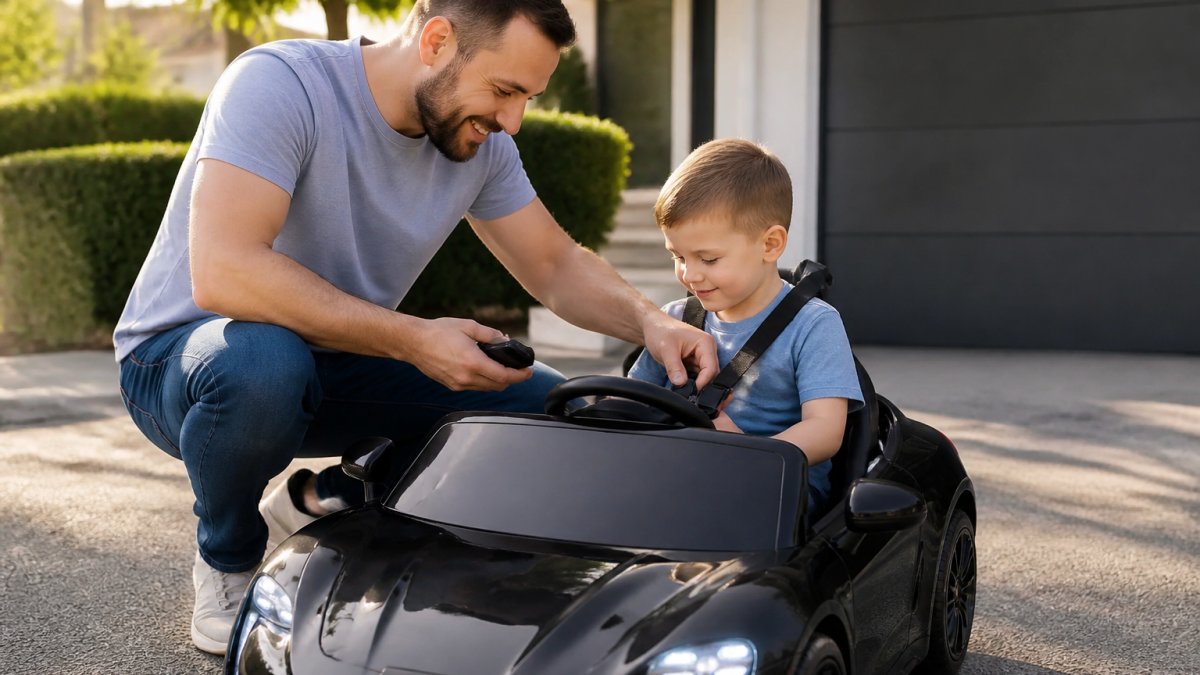
Soft start deserves a callout. It ramps acceleration gradually instead of jolting forward, which stops the head-snap that spooks small riders on cheap models.
A 2020 review of modified ride-on car use found that perceived barriers, not vehicle capability, often limit how much families use these toys, as documented in research on ride-on car barriers.
Remote control is the single biggest safety upgrade. Our electric ride on cars with remote control let you take full control or park instantly.
How Long Do Ride-On Cars Last? Durability and Age-Out Risk
Most ride-on cars last three to five years with basic care, but age-out, not breakdown, usually ends their run first.
A 12V battery degrades with every deep discharge. Store it charged, avoid leaving it drained over winter, and you extend usable runtime noticeably.
That is the honest math behind "worth it." A $559 car used for four years costs about $140 per year. A $180 car replaced twice in the same window costs $360 and delivers worse performance the whole time.
Our electric ride-on car maintenance guide covers storage, tire care, and the checks that prevent mid-season failures.
Total Cost of Ownership: The Math Behind a $559 Purchase
The purchase price is roughly 70% of what a premium ride-on actually costs you. The rest is battery replacement, parts, and your time.
Here is the breakdown for a typical four-year run:
| Cost Item | Budget Model | Premium Model |
|---|---|---|
| Purchase price | $180 | $559 |
| Replacement batteries (2 vs 1) | $90 | $45 |
| Replacement parts | $60 | $20 |
| Replacements needed | 2 cars | 1 car |
| Four-year total | $690 | $624 |
The premium car wins by a modest margin on pure dollars. It wins by a wide margin on everything else: fewer assembly headaches, better resale, and a child who is not steering a rattling shell.
Repairability is the hidden variable. For battery troubleshooting, see our guide on how to fix a ride on car battery.
Battery Life, Motor Power, and Real-World Performance
Battery claims deserve skepticism. A "hours of fun" promise on a budget listing usually means one hour on flat pavement at half throttle. The only way to know what a ride-on actually does is to measure it under the conditions your child will drive in, so here is what real-world testing looks like, and what the numbers mean.
What to measure, and how
A useful test records four things: runtime on a full charge, charging time from empty, top speed on flat pavement, and top speed on grass or a mild slope. Run each test with a rider near the middle of the weight range, because a heavier rider drains the pack faster. Note the surface and the throttle setting, since a car that runs 60 minutes at half throttle may run 35 at full.
A common pattern across 12V models: a 12V 4.5Ah battery delivers roughly 40-60 minutes of mixed riding on pavement, dropping toward 30-40 minutes on grass. A 24V 9Ah pack with dual 300W motors pushes harder but drains faster under load, so the runtime gap between pavement and grass widens.
Why motor count beats raw voltage
Motor count matters more than raw voltage for everyday use. Dual 25W motors handle a slight incline and uneven terrain that stall a single-motor car. Voltage tells you the ceiling; motor count tells you whether the car can actually use it.
Four-wheel suspension then keeps the ride smooth enough that kids actually want to keep driving, and a car that gets driven is a car that delivers the value you paid for.
Charging time and battery care
Most 12V packs charge in 8-12 hours from empty; 24V packs take longer. Charge after every use, store the battery charged, and top it up monthly during off-season storage. A 12V battery degrades with every deep discharge, so the family that plugs in after each ride gets noticeably more usable runtime over four years than the family that lets the car sit drained.
When you shop, ask for measured runtime on grass, not just the marketing range. A seller who can give you that number is a seller who tested the car.
Who Should Buy Premium (and Who Shouldn't)
Buy premium if your child is between 4 and 8, you have grass or uneven pavement, and you want one car to last through siblings. The remote control alone justifies it for a first-time rider.
Skip premium if your child is already 9 or 10 and near the weight limit, if you have no safe flat surface to drive on, or if the car will be used a handful of times a year. A budget model fits those cases fine.
Storage is the underrated dealbreaker. These cars take up real garage space, and a premium model you cannot park is worse than a smaller one you can.
The middle path works too: buy a mid-tier model with a genuine parental remote and skip the cosmetic extras. Control and suspension are worth paying for. Hydraulic doors are fun, not essential.
Frequently Asked Questions
Are ride-on cars worth it compared to cheaper alternatives?
It depends on what you value. Budget ride-on cars typically save money upfront but often cut corners on suspension, battery capacity, and parental controls. Premium models like the VroomVroomToy RR at $559 include 4-wheel shock absorbers, soft start, and a 2.4GHz remote that lets you stop the car instantly. If your child will use it regularly for two or more years, the durability and safety features usually justify the higher price. If it is a short-term novelty, a budget model may be enough.
Are premium ride-on cars safer than budget models?
Premium models tend to include safety features that budget versions often skip: 2.4GHz parental remotes with emergency stop, soft start to prevent sudden jolts, adjustable seatbelts, and locking doors. The VroomVroomToy JP, for example, adds a 3-point seatbelt and locking doors at $559. That said, no ride-on car replaces adult supervision. Always check the age range, weight limit, and speed settings before letting a child drive independently.
How long do ride-on cars last?
A well-built ride-on car can last three to five years with regular use, depending on battery care and surface conditions. Battery life per charge varies by model: the VroomVroomToy MC runs 40 to 60 minutes, while the Police SUV runs 1 to 2 hours. Storing the battery indoors and avoiding deep discharges extends its lifespan. Replacement parts availability matters too, which is why buying from a brand with US-based support reduces long-term headaches.
What features make an expensive ride-on car worth the price?
Look for four things: a parental remote with emergency stop, suspension that handles grass and uneven terrain, a battery that delivers consistent runtime, and safety details like seatbelts and soft start. The VroomVroomToy Go Kart at $599 adds dual 300W motors and an 8 MPH top speed for older kids, while the MC at $599 includes hydraulic doors and a 12V 4.5Ah battery. These features cost more to build, and they are what separate a toy that lasts from one that breaks in months.
The real question is not whether expensive ride-on cars cost more, but whether the extra buys safety and years of use. At VroomVroomToy, every vehicle ships with a 2.4GHz parental remote, four-wheel suspension, and free US shipping, backed by USA-based support and a 30-day return policy. Start with the Ride On Electric Toy Car RR at $559 or step up to the MC for hydraulic doors. Shop now and give your little driver a car built to last.


