
7 Scissor-Door Ride-On Cars for Kids: What Parents Need to Know
Last Updated: October 26, 2026
Quick Summary
Scissor-door ride-on cars combine realistic sports car styling with functional doors that open upward, creating an immersive driving experience for children. Unlike traditional ride-on vehicles with fixed bodies, scissor-door ride-on cars replicate the excitement of high-end supercars by requiring hydraulic or mechanical systems that add complexity and durability to the frame.
- Most 12V ride-on cars deliver 1 to 2 hours of continuous runtime with charging times of 8 to 12 hours for a full recharge.
- Parental remote control with 2.4GHz wireless connection allows adults to override the child's steering and pedals for real-time safety intervention.
- Scissor-door mechanisms require periodic lubrication and proper assembly alignment to operate smoothly and ensure long-term reliability.
- Children should never operate scissor-door vehicles without adult supervision due to pinch hazards from the moving door mechanism.
- Battery replacement typically becomes necessary after 2 to 3 years with proper maintenance and regular charging practices.
Table of Contents
- What Makes Scissor-Door Ride-On Cars Different
- Kids Lamborghini Ride-On Cars: Realistic Styling and Licensed Details
- 12V Ride-On Car with Remote Control: How Parental Override Works
- Ride-On Car Battery Life and Charging Time: What to Expect
- Kids' Ride-On Car Safety Features That Matter
- Common Mistakes When Choosing a Scissor-Door Ride-On Car
- Getting Your Scissor-Door Ride-On Car Ready to Drive
- Frequently Asked Questions
What Makes Scissor-Door Ride-On Cars Different
Scissor-door ride-on cars combine realistic sports car styling with functional doors that open upward, creating an immersive driving experience for children. Unlike traditional ride-on vehicles with fixed bodies, scissor-door models replicate the excitement of high-end supercars, letting kids feel like they're piloting a real Lamborghini or similar luxury vehicle.
The key difference lies in engineering. Scissor doors require hydraulic or mechanical systems that add complexity and durability to the frame. This means the vehicle's overall construction must be sturdier to support the door mechanism while maintaining safety during operation. Standard ride-on cars skip this entirely, using simple fixed bodies that prioritize simplicity over immersion.
Product listings emphasize realistic styling and entertainment features alongside scissor doors. A 12V Lamborghini-style ride-on with scissor doors, remote control, LED lights, Bluetooth, and MP3 capability represents the modern standard. These vehicles appeal to affluent parents seeking premium outdoor toys that combine function with fantasy, children get genuine driving practice while experiencing the thrill of luxury car aesthetics.
The real advantage surfaces during play. When a child can open and close their own doors, the imaginative experience deepens. They're not just sitting in a toy; they're inhabiting a character, a scenario, a fantasy. That engagement translates into longer play sessions and more active outdoor time.
Kids Lamborghini Ride-On Cars: Realistic Styling and Licensed Details
Licensed sports-car styling transforms a ride-on vehicle from generic toy into a miniature supercar. Manufacturers partner with automotive brands to replicate proportions, color schemes, and design cues that children recognize from real vehicles.
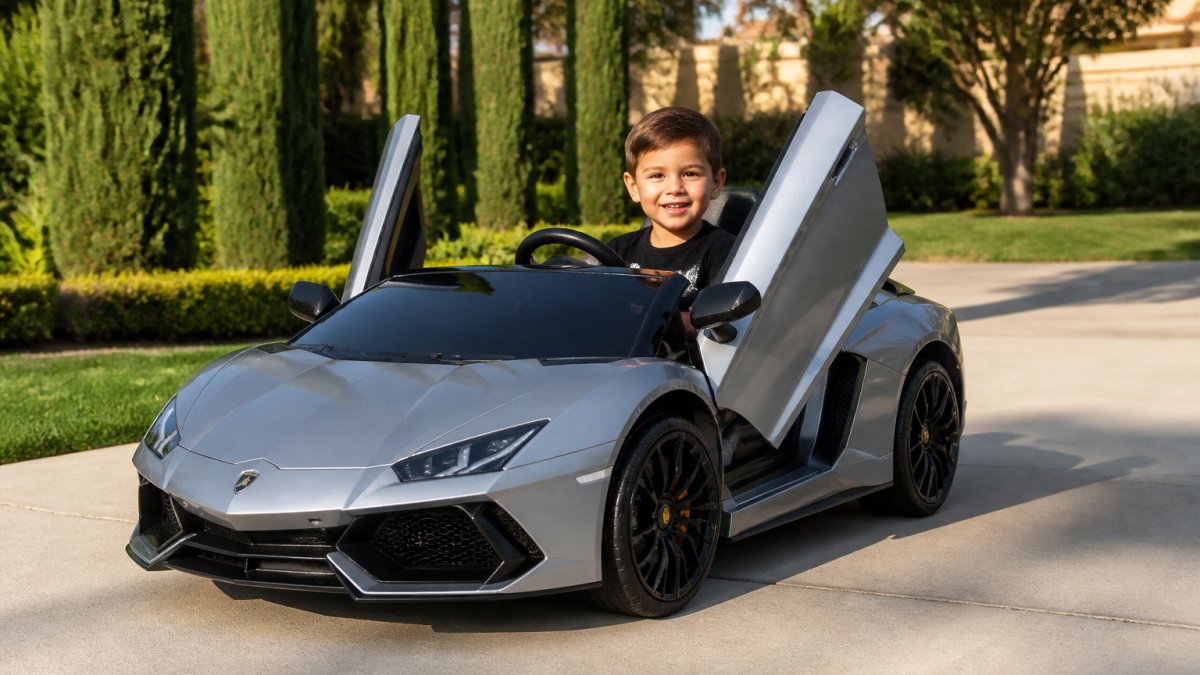
These details matter because they drive engagement. Children respond to authenticity, even scaled-down versions. LED headlights that actually illuminate, working horn sounds, and realistic engine audio create a multisensory experience. When combined with Bluetooth connectivity for music playback, the vehicle becomes an entertainment platform, not just transportation.
Licensed styling also signals quality to parents. A recognizable brand name attached to a ride-on vehicle suggests manufacturer investment in design accuracy and durability. Parents shopping for premium options understand that licensing fees reflect commitment to authenticity.
Realistic details extend to proportions and ergonomics. Licensed models often include adjustable seats, properly positioned steering wheels, and foot pedals designed for small feet. These refinements make the driving experience feel less like sitting in a toy and more like operating a miniature vehicle.
12V Ride-On Car with Remote Control: How Parental Override Works
A 12V ride-on car with remote control gives parents real-time authority over vehicle movement, speed, and direction. This feature addresses the core safety concern: young children lack the judgment and motor control to navigate complex environments safely.
The mechanics are straightforward. Most systems use a 2.4GHz wireless connection between the handheld remote and the vehicle's receiver. When a parent engages the remote, it overrides the child's inputs.
Real-world application reveals why this feature resonates with safety-conscious parents. A child might aim directly toward a driveway edge or a younger sibling. With remote control, parents can steer the vehicle away from danger without stopping play. The child continues their adventure while adults manage risk in the background.
National Highway Traffic Safety Administration guidance on child vehicle safety emphasizes the importance of age-appropriate supervision and environmental control. Remote control features align with this philosophy by helping parents to manage both the child's actions and the playing environment simultaneously.
Some ride-on listings pair scissor doors with parental-control or speed-selection features, creating layered safety architecture. A vehicle with both remote override and adjustable speed modes gives parents multiple intervention points. They can limit maximum velocity, monitor driving via remote, and adjust settings based on the child's skill development.
Ride-On Car Battery Life and Charging Time: What to Expect
Battery performance determines how long your child can actually play before recharging becomes necessary. Most 12V ride-on cars deliver 1 to 2 hours of continuous runtime under normal conditions. This duration depends heavily on terrain, weight, motor efficiency, and driving style. A child driving gently on flat pavement will see longer runtimes than one accelerating hard on grass.
Charging times typically range from 8 to 12 hours for a full recharge using standard chargers. This overnight-recharge model suits most families, charge after play sessions end, and the vehicle is ready by the next day. Faster chargers exist but often cost extra and may reduce battery lifespan if used repeatedly.
Battery replacement eventually becomes necessary. Most ride-on car batteries last 2 to 3 years with proper maintenance. Replacement 12V batteries are widely available and cost significantly less than purchasing a new vehicle. Understanding this replacement cycle helps parents budget for long-term ownership.
The key mistake parents make is leaving vehicles uncharged for extended periods. Lithium and lead-acid batteries both degrade when sitting empty. If your child won't use the ride-on car for several weeks, charge it monthly to maintain battery health. This simple practice can add a full year to battery lifespan.
For families with multiple children or extended play sessions, consider purchasing a spare battery. This approach eliminates downtime, while one battery charges, the other powers play.
Kids' Ride-On Car Safety Features That Matter
Safety features separate premium ride-on cars from budget alternatives. A functional safety belt keeps children seated during acceleration and turns. Adjustable belts accommodate growing children and ensure proper fit, too loose and the belt fails to restrain, too tight and it becomes uncomfortable enough to discourage use.
Stable body design with four-wheel suspension creates a low center of gravity that resists tipping during turns. This engineering choice matters on uneven terrain where children might drive. A wider wheelbase and lower seat position make the vehicle inherently more stable than narrow, high-seated designs.
LED headlights serve a dual purpose: they enhance the realistic driving experience and improve visibility during low-light play. A child operating a vehicle with working lights develops better awareness of lighting conditions and visibility, practical knowledge that transfers to real-world driving education later.
Watch out: Children should never operate scissor-door vehicles without adult supervision, regardless of remote control features. The door mechanism itself presents a pinch hazard if a child's fingers are near moving parts. Proper setup and clear safety instructions before first use are non-negotiable.
According to Kids and Cars safety research, at least 1,198 children have died in hot cars since 1990, highlighting the critical importance of environmental supervision. While scissor-door ride-on cars operate in controlled outdoor settings, the principle remains: children need active adult oversight. Safely supervise your child's ride-on car use by reviewing VroomVroomToy's detailed supervision guidelines.
Common Mistakes When Choosing a Scissor-Door Ride-On Car
The first mistake is prioritizing doors over age-appropriate fit. A child who cannot comfortably reach the pedals or see over the steering wheel will struggle to drive safely, regardless of how impressive the scissor doors look.
Second, parents often overlook battery specifications. A 12V system delivers adequate power for children under 100 pounds on flat terrain. Heavier children or hilly environments demand more power, and undersizing the battery capacity leads to disappointing performance and frustrated children.
Third, many buyers ignore remote control range and frequency. A 2.4GHz remote with 100-foot range works reliably in most residential settings. Older 27MHz systems suffer from interference and shorter ranges.
Fourth, skipping the assembly process review creates frustration. Some require specialized tools or mechanical knowledge to assemble correctly. Choose a ride-on car that matches your assembly comfort level by reviewing VroomVroomToy's detailed selection guide, which covers assembly requirements, tool needs, and estimated setup time.
Fifth, parents underestimate maintenance needs. Scissor doors need periodic lubrication to operate smoothly. Batteries require proper charging protocols. Tires need occasional pressure checks. Vehicles neglected for months often fail to operate reliably when finally brought out.
Sixth, comparing only price misses value entirely. A cheaper ride-on car with poor build quality, weak battery performance, and unreliable remote control creates a worse experience than a premium option that delivers consistent performance.
Getting Your Scissor-Door Ride-On Car Ready to Drive
Preparation begins with assembly. Most scissor-door ride-on cars arrive partially assembled. Follow the manufacturer's instructions precisely, as door mechanisms require careful alignment.
Next, charge the battery fully before the first driving session. New batteries benefit from a complete charge cycle before use. This priming process optimizes battery chemistry and ensures maximum runtime.
Test the remote control range and functionality in an open space before allowing your child to drive.
Inspect the play environment. Remove obstacles, rocks, and debris that could puncture tires or damage the undercarriage. Identify boundaries, a driveway, fenced yard, or marked area, where your child will operate the vehicle.
Introduce your child to the vehicle gradually. Start with stationary exploration, let them sit in the seat, practice steering inputs, and get comfortable with the controls.
Review safety rules explicitly. Explain the purpose of the safety belt, demonstrate proper door operation, and establish clear consequences for unsafe behavior.
VroomVroomToy's complete product collection includes scissor-door models at various price points and with different feature sets. Browse our selection to find the ride-on car that matches your child's age, size, and skill level.
Choosing the right scissor-door ride-on car requires balancing excitement with safety, realistic styling with age-appropriate fit, and upfront cost with long-term durability.
| Feature | Why It Matters | What to Check |
|---|---|---|
| Scissor door mechanism | Creates immersive play experience | Smooth operation, no binding |
| 12V battery system | Powers realistic performance | Runtime expectations, charging time |
| Parental remote control | Enables real-time safety intervention | Range, frequency, override reliability |
| Adjustable safety belt | Keeps child secure during movement | Fit at multiple growth stages |
| LED headlights | Improves visibility and realism | Brightness, battery drain |
| Weight capacity | Ensures safe operation for your child | Your child's current and projected weight |
| Terrain capability | Determines where vehicle can operate safely | Driveway, grass, or mixed surfaces |
| Assembly complexity | Affects setup time and potential issues | Tools required, estimated hours |
Frequently Asked Questions
What age is appropriate for a scissor-door ride-on car?
Most scissor-door ride-on cars are designed for children ages 3 to 8, though fit depends on your child's height and weight. Check the manufacturer's weight capacity and seat dimensions before purchasing. Younger children (3-5) benefit most from parental remote control, while older kids (6-8) can operate child controls with supervision. Always ensure your child can reach the pedals and sit securely in the seat with the safety belt fastened.
How long does a 12V ride-on car battery last on a single charge?
Most 12V ride-on car batteries provide 1 to 2 hours of continuous drive time, depending on terrain, weight, speed setting, and battery condition. Flat surfaces and lower speed modes extend runtime. Charging typically takes 8 to 12 hours. Battery runtime decreases over time as the battery ages; most replacements are needed after 2 to 3 years of regular use. Always charge fully before first use and after each play session for best performance.
Are scissor doors on kids' ride-on cars powered or manually operated?
Most scissor-door ride-on cars feature hydraulic or electric-assist doors that open automatically when activated, rather than manual hinges. This adds to the realistic supercar experience and appeals to children who love the theatrical effect. However, the door mechanism is separate from the drive system and does not affect the vehicle's performance or battery life significantly. Always supervise young children around opening doors to prevent pinching.
What safety features should I prioritize in a kids' ride-on car?
Look for adjustable safety belts, a low center of gravity, four-wheel suspension for stability, and a parental remote control with override capability. LED headlights improve visibility during dusk play. Speed-selection modes (high/low) let you limit acceleration for younger or less experienced drivers. Sturdy construction and wear-resistant wheels reduce tipping and improve all-terrain use. Always supervise play and ensure your child wears appropriate protective gear.


